
By : By Claudio Pozzi http://www.qsl.net
My first transmission experiments on 136 kHz
band
where based on a little TX build around surplus components,
particularly
the output transformer was wound on a TV EAT transformer. In Italy is
impossible
to find Philips 3C85 cores.
For 200W transmitter I decided a more
professional
approach: buy a surplus switching power supply core and design the
output
transformer according to ARRL Handbook suggestions.
The success was assured at the first try, so I
publish
my experience for all people interested in this band.
2. Design requirements
- Power supply: my biggest transformer was 200 W 30 V, coming from an old HI-FI amplifier
- Output transformer core: coming from flea market, light blue color, marked as A-438281-2-9H9-3, OD = 47 mm, ID = 24 mm, height = 13 mm. No information about µ
- Output impedance: variable, about 50 ohm.
- Configuration: class D single mosfet
- Mosfet to be used: coming from flea market, with the following characteristics. It's an obsolete (no data sheet could be retrieved) and cheap (1 euro) device and is similar to the well known IRFP450.
|
3. Design steps
3.1. Measuring the toroid permeability
Wind the toroid with some turns, use any kind of
insulated wire and, according with the table 1, measure the
inductance
with a suitable instrument.
Then using the TOROID program (TNX G4FGQ, R. J.
Edwards), input the mechanical dimensions, try some permeability values
ad find the µ value that give a computed inductance close to the
measured one (if you are a perfectionist do some form of regression).
In
my case a µ = 180 resulted in the values reported in the third
line
of the table 1.
|
|
||||||
|
Number of turns (N)
|
|
|
|
|
|
|
|
Measured inductance (L, µH)
|
|
|
|
|
|
|
|
|
|
|
|
|
|
|
3.2. Dimensioning the output stage
Starting with my power
supply characteristics I compiled the table 2 with five
hypotheses
based on my power supply transformer.
|
|
|||||
|
Hypothesis
|
|
|
|
|
|
|
Vdc (V)
|
|
|
|
|
|
|
Idc (A)
|
|
|
|
|
|
|
Pin (W)
|
|
|
|
|
|
|
Pout (W)
|
|
|
|
|
|
|
Zout (ohm)
|
|
|
|
|
|
|
XL (ohm) (= 6 x
Zout)
|
|
|
|
|
|
|
L (µH) @ 136 kHz
|
|
|
|
|
|
Pout was computed estimating an efficiency of
80%.
Zout was computed using the ARRL handbook
simplified
formula:
The
complete formula should consider the voltage drop on the mosfet:
If
you
are designing a push pull stage you can apply the following formula:
(TNX
G0MRF, David Bowman)
The
ARRL handbook suggests that RF non resonant transformer must have an
inductive
reactance (XL) at least 4 times the impedance. I decided to
use XL= 6 times the impedance.
On the basis of the preceding experience I decided
for the column 5 hypothesis, so for primary winding:
From
table
1 the primary winding must have 10 turns (28,3 µH).
The secondary winding should match the antenna
impedance,
in my case about 50 ohms. Table 3 report the secondary winding
turns,
computed with the following formula:
|
|
|||||
|
Number of turns
|
15
|
20
|
25
|
30
|
35
|
|
Z secondary (ohm)
|
9,2
|
16,4
|
25,6
|
37
|
50
|
3.3. Measures on the running prototype
The transmitter was connected to the antenna
and,
starting from the first tap on the transformer (15 turns) I searched
what
tap was better (maximum antenna current for Idc < 6A). If you have a
dummy load you can do a better test. In my case 30 turns tap resulted
in
the following table measured values:
- Vdc = 32 V
- Idc = 5.8 A
- Pin = 186 W
- Pout = 150 W (for an efficiency of 80%)
- Zout = 3.3 ohm (see formula 1)
- Npri = 10 turns
- Nsec= 30 turns (the better tap)
- Iant = 1.7 A (measured antenna current)
- Computed antenna resistance (Pout / Iant2) = 52 ohm
- Measured antenna resistance = 50 ohm (about one month later)
The transformer turn ratio (10 / 30) confirms
the
impedance matching from the 3.3 ohm of the output stage to the 50 ohm
of
the antenna system (see formula 3).
The running equipment seems closer to the column
3 of the table 2 hypotheses.
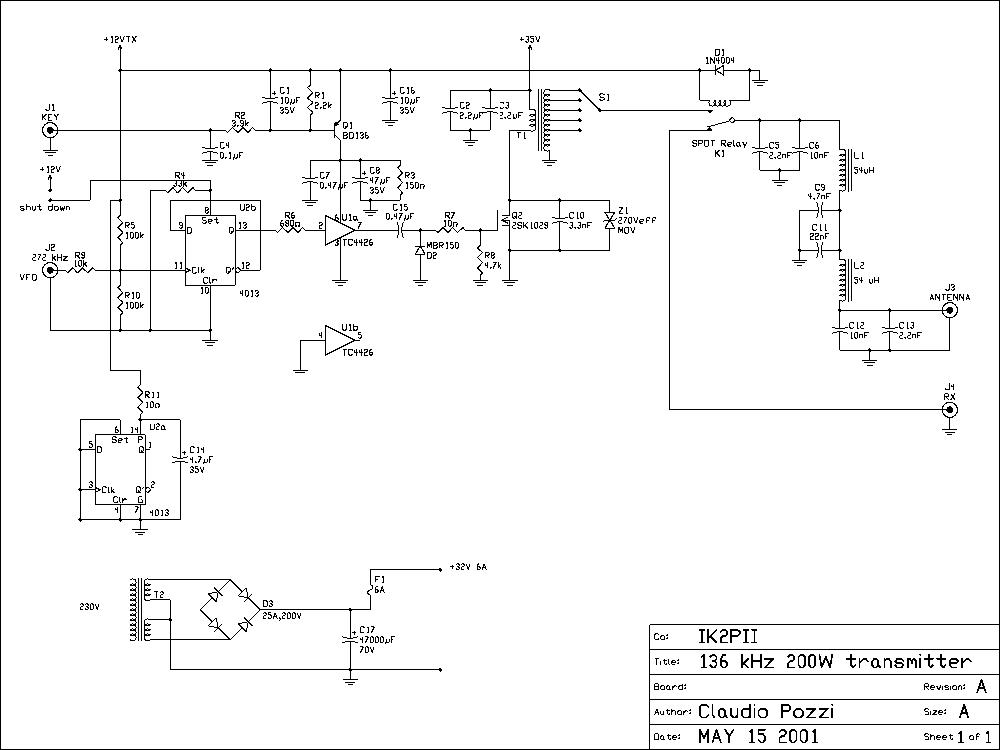
4. Circuit description
The TX was built on an unetched printed circuit
board, a very good earth plane, using the dead bug technique.
The TX must be excited with a double frequency
(272
kHz); this is better for the following motivations:
- The exciter is good also for a coming soon push pull transmitter
- The flip-flop give a symmetrical square wave output
- During receiving time the flip-flop is unpowered, so no 136 kHz signal is injected into the receiver.
The input stage can handle a 5 to 12 V pp signal
(TTL or CMOS, probably, but not tested, also sinusoidal signals). My
Xtal
oscillator uses an ex CB Xtal 27.xxx MHz divided by 100.
The TC4426 must have very short wires bypass
capacitors,
soldered to the ground plane.
The BD136 transistor on a little heat sink
handles
the CW (or QRSS) manipulation. The circuit come from well known 136 kHz
transmitters.
The capacitor C15 between the TC4426 and the
mosfet
gate protect the mosfet from destruction in the case of carrier absence.
The mosfet is mounted on a heat sink coming from
an old Pentium 2 CPU, with the little fan running at 12 V. Another fan
in the box keeps the temperature of the transmitter comfortable; the
source
pin go to the ground plane directly.
The by-pass capacitors C2 e C3 must be of the
best
quality you can find, rated to 4 times Vdc, I use two 1 µF and
one
2,2 µF polyester 250 volt in parallel. Don't use electrolytic
capacitors
and keep the terminals as short as possible.
The primary winding of T1 is 1 mm2 Teflon
insulated wire, the secondary 1 mm2 enameled wire.
The Z1 varistor, in my case, is not mounted: no
mosfet explosions at this time!
The low pass output filter is copied from other
lowfers projects.
5. Possible variations
It's possible to design the output stage for
other
power supply. Following are the maximum suggested limits for the mosfet
employed:
- Vdc 90 volt max.
- Idc 6 - 7 ampere max.
- Pin 250 watt
For lower voltages and higher currents consider
a bigger heat sink.
6. References
This project was possible thanks the very good
job
done by other lowfers and published on the WEB.
http://www.alg.demon.co.uk/radio/136/home.htm
Steve Rawlings, GW4ALG
http://www.picks.force9.co.uk
Dave Pick, G3YXM
http://www.g0mrf.freeserve.co.uk
David Bowman, G0MRF
http://www.btinternet.com/~g4fgq.regp
R. J. Edwards, G4FGQ: the TOROID program download page
|
|
||
|
C1
|
10µF 35V
|
Electrolytic
|
|
C2
|
2.2µF 250V
|
Polyester
|
|
C3
|
2.2µF 250V
|
Polyester
|
|
C4
|
0.1µF
|
Ceramic
|
|
C5
|
2.2nF 1000V
|
Polyester
|
|
C6
|
10nF 1000V
|
Polyester
|
|
C7
|
0.47µF
|
Ceramic
|
|
C8
|
47µF 35V
|
Electrolytic
|
|
C9
|
4.7nF 1000V
|
Polyester
|
|
C10
|
3.3nF 1000V
|
Ceramic
|
|
C11
|
22nF 1000V
|
Polyester
|
|
C12
|
10nF 1000V
|
Polyester
|
|
C13
|
2.2nF 1000V
|
Polyester
|
|
C14
|
4.7µF 35V
|
Electrolytic
|
|
C15
|
0.47µF 250V
|
Polyester
|
|
C16
|
10µF 35V
|
Electrolytic
|
|
C17
|
47000µF 70V
|
Electrolytic
|
|
D1
|
1N4004
|
|
|
D2
|
MBR150
|
Schottky 150V
|
|
D3
|
25 A 200 V
|
Bridge
|
|
F1
|
6.3 A
|
|
|
J1
|
|
Key connector
|
|
J2
|
|
VFO connector
|
|
J3
|
|
ANTENNA connector
|
|
J4
|
|
RX antenna connector
|
|
K1
|
SPDT Relay, 12V
|
|
|
L1
|
54uH
|
Amidon T200-2, 64 turn
1 mm diam.
enameled
|
|
L2
|
54uH
|
Amidon T200-2, 64 turn
1 mm diam.
enameled
|
|
Q1
|
BD136
|
With heat sink
|
|
Q2
|
2SK1029
|
With heat sink and fan
|
|
R1
|
2.2k
|
|
|
R2
|
3.9k
|
|
|
R3
|
150 ohms 2W
|
|
|
R4
|
33k
|
|
|
R5
|
100k
|
|
|
R6
|
680 ohms
|
|
|
R7
|
10 ohms 2W
|
|
|
R8
|
4.7k
|
|
|
R9
|
10k
|
|
|
R10
|
100k
|
|
|
R11
|
10 ohms
|
|
|
T1
|
|
See text
|
|
T2
|
2 x 30V 200W
|
Power supply transformer
|
|
U1a
|
TC4426
|
|
|
U1b
|
TC4426
|
Not used, ground the
input
|
|
U2a
|
4013
|
Not used, ground the
inputs
|
|
U2b
|
4013
|
|
|
Z1
|
270Veff
|
MOV or Varistor, not
mounted
|
|
|
|
|


No comments:
Post a Comment